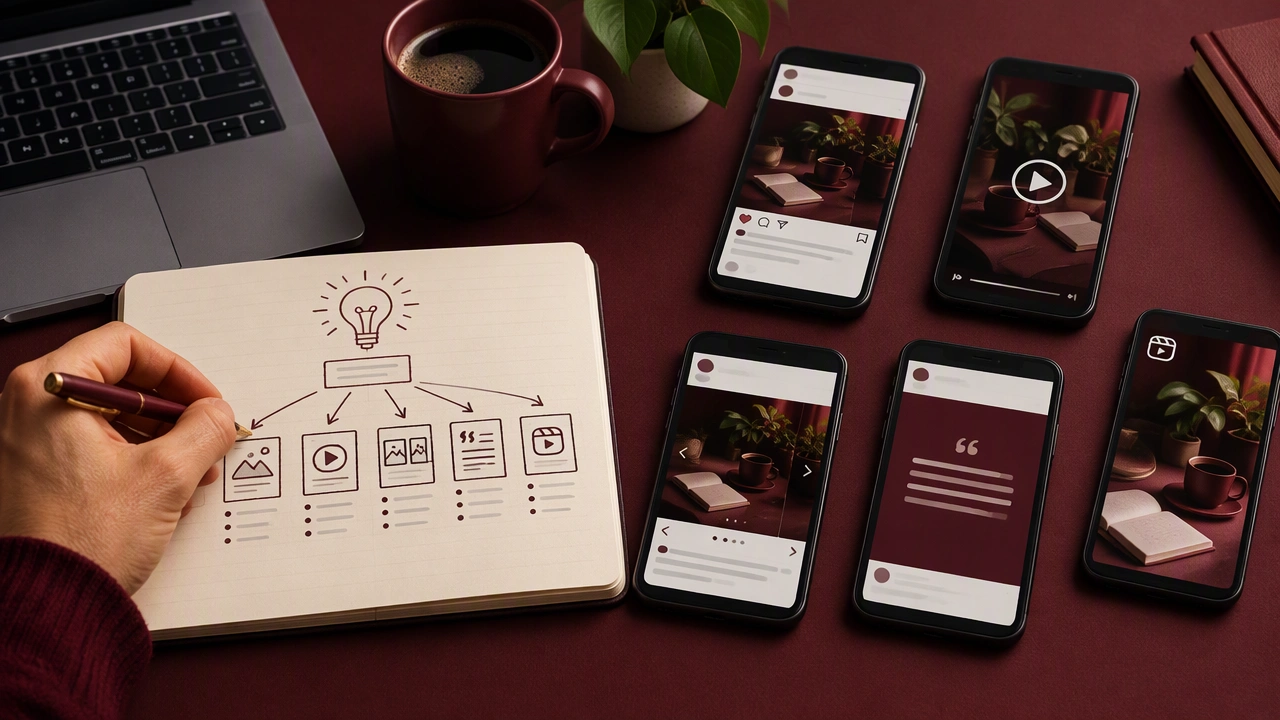
How to Stretch One Strong Idea Into Five Different Post Formats

A strong idea rarely needs to be replaced after a single use. It needs to be translated. When you know how to repurpose one content idea into five different posts, you can build a week of social media content from one clear thought while keeping each post useful, fresh, and easy to absorb.
The goal is not to copy the same message five times. The goal is to explore five distinct reader needs around the same core idea: understanding it, remembering it, applying it, questioning it, and discussing it. Once you see those needs as a structure, planning becomes calmer and much less repetitive.
Start with one idea worth repeating
Choose an idea that is specific enough to guide action but broad enough to support more than one angle. A useful test is to ask: what should the reader understand or do after hearing this idea?
Strong candidates often include a principle, a process, a misconception, a decision framework, or a lesson from experience. Weak candidates are vague topics such as “be more consistent” or “create better content.” Those are themes, not ideas.
Write the idea in one sentence before you plan any formats. For example: Planning posts around a single reader problem makes content easier to create and easier to remember. That sentence becomes your source material.
Use five formats for five different jobs
Each format should do a job the others do not. This is the key to avoiding repetition. The subject stays consistent, but the experience changes.
1. A short explanatory post
Begin with the clearest version of the idea. Explain what it means, why it matters, and where it applies. Keep the language direct and avoid adding extra concepts that blur the main point.
This post works best when it helps a reader who is encountering the idea for the first time. Use a simple structure: context, insight, practical implication. A strong opening line can name the problem, and the final lines can show what changes when the idea is applied.
Do not try to include every detail here. The purpose is clarity, not completeness.
2. A step-by-step carousel or list post
Turn the idea into a sequence the reader can follow. If the idea is about planning, the sequence might be: define the audience problem, choose the core message, select the format, write the first draft, and review it for repetition.
Each step should be short enough to scan and specific enough to act on. Use strong verbs and consistent phrasing. The list format gives the idea a different rhythm, so it feels like a practical tool rather than a repeated explanation.
Ask yourself: what would a reader do next after understanding this? Your steps should answer that question.
3. A personal story or behind-the-scenes post
Stories make abstract ideas concrete. Choose a moment when the idea helped you solve a real problem, avoid a mistake, or change a decision. Describe the situation briefly, show the tension, and explain what you learned.
You do not need a dramatic transformation. A small, honest example can be more useful than a polished success story. The reader should be able to recognize the same situation in their own work.
This format adds emotional texture. It also gives the audience a reason to trust the idea because they can see where it came from.
4. A contrarian or myth-breaking post
Use the idea to challenge a common assumption. Start with the familiar advice, show where it breaks down, and offer a more useful way to think.
For example, if the idea is about repurposing content, a myth-breaking post might reject the belief that every post must be completely original. The point is not to provoke for its own sake. It is to remove a barrier that keeps people from using a practical method.
Keep the tone measured. You are correcting a pattern of thinking, not attacking people who hold it. End with a clearer standard the reader can use.
5. A question-led discussion post
The fifth post should invite participation rather than deliver another lesson. Ask a focused question that makes the audience reflect on their own experience.
Good discussion prompts are specific. Instead of asking, “What do you think?” try, “Which part of your content process takes the most energy, and why?” The question should connect directly to the original idea while leaving room for different answers.
You can also offer two or three possible positions and ask readers to choose. This lowers the effort required to respond and creates more varied replies.
Keep the spine consistent while changing the surface
Across all five posts, preserve a recognizable spine: the same audience, the same problem, and the same core belief. Change the surface through structure, tone, examples, and level of detail.
Use these checks before publishing:
- Does each post solve a different reader need?
- Would the posts make sense if they appeared on the same day?
- Is the central idea clear without forcing the same wording?
- Does each post give the reader something useful on its own?
If two posts feel interchangeable, merge them or change one into a new angle. Repetition becomes a problem only when the format and the purpose are also the same.
Build a simple repurposing routine
Set aside one planning session for the source idea. Write the one-sentence foundation, then create five headings, one for each format. Draft the easiest post first, because it will reveal the clearest language. Use that language as a reference, not as a script.
Place the posts across the week rather than publishing them together. Spacing gives each version room to stand alone and helps you notice which angle generates saves, replies, or useful conversations.
After publishing, record what worked: which question earned thoughtful responses, which example was easiest to understand, and which format felt most natural to create. Those observations become your next planning advantage.
Repurposing should feel like expansion, not recycling
When each format has a distinct job, five posts can feel like five contributions rather than one message repeated. You are helping different readers enter the idea from different directions, and you are giving the same idea enough time to become memorable.
Start with one thought you genuinely understand. Turn it into an explanation, a process, a story, a challenge, and a conversation. That is how to repurpose one content idea into five different posts without losing freshness, clarity, or your own voice.