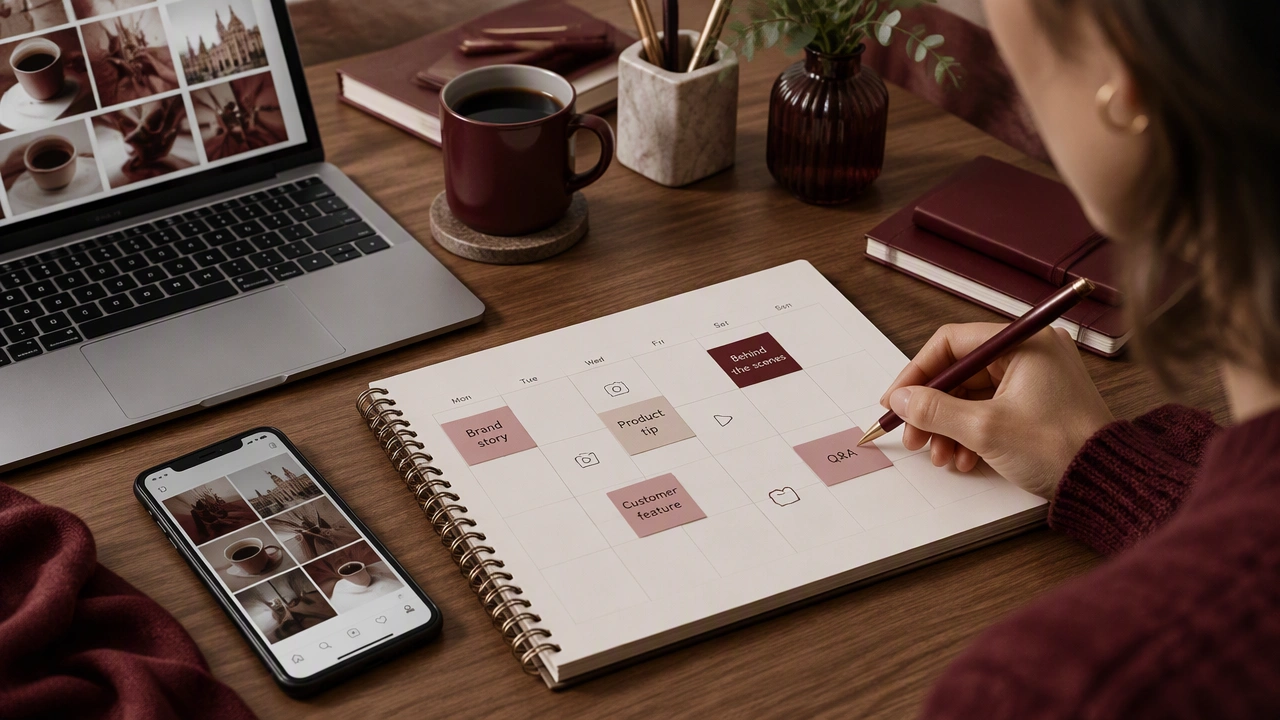
A Beginner’s Guide to Intentional Social Media Planning

This social media planning guide for intentional posting with purpose explains how to move from random publishing to a calm, repeatable system. You will learn what intentional posting means, why planning matters, and how to make sure every post has a clear reason for existing.
What intentional posting means
Intentional posting means choosing to publish content for a defined reason rather than because a slot is empty or an idea appeared at the last minute. Each post should connect to a goal, an audience need, or a stage in a simple journey from awareness to action.
That reason does not need to be complicated. A post might introduce your work, answer a common question, show proof, start a conversation, or invite someone to take one clear next step. The point is to know which job the post is doing before you write it.
Why planning matters
Planning gives your content direction. Without a plan, it is easy to react to trends, repeat the same message, or publish whenever time allows. A plan helps you balance education, trust, and action so your feed supports real goals.
Planning also reduces decision fatigue. When the purpose, format, and timing of a post are already clear, you can focus on writing well instead of asking what to share today. Over time, this makes consistency easier to maintain.
Planning does not mean being rigid
A good system leaves room for timely posts, comments, and new ideas. Planning is a framework, not a prison. You can adjust the schedule when something relevant happens while keeping the overall direction steady.
Start with one clear goal
Choose a primary goal for your social media effort for the next four to eight weeks. Examples include growing qualified reach, building trust with a specific audience, driving traffic to a resource, or generating conversations that may become opportunities.
Write the goal in one sentence that includes an outcome and a timeframe. Then ask what kind of content would naturally support that outcome. This simple link between goal and content is the foundation of intentional posting.
Define the audience and their questions
Intentional content starts with a clear picture of the people you want to reach. Describe their role, situation, goals, and current obstacles in plain language. Avoid broad labels such as “everyone” because they make messaging vague.
List the questions they ask before, during, and after choosing a solution like yours. These questions become useful content topics. A post that answers a real question has a built-in reason to exist and is easier for the audience to understand.
Build three to five content pillars
Content pillars are repeatable themes that organize your ideas. Three to five pillars are usually enough. Each pillar should support your goal and reflect what your audience cares about.
For example, a consultant might use pillars such as practical how-to advice, common mistakes, client thinking processes, professional perspective, and a clear invitation to work together. A local service business might use seasonal care tips, behind-the-scenes explanations, frequently asked questions, community stories, and offers.
Assign each pillar a purpose. One pillar may educate, another may build trust, and another may invite action. This prevents your feed from becoming a stream of unrelated posts.
Give every post a reason
Before creating a post, complete this short statement: “This post exists so that [audience] will [useful outcome].” The outcome might be learning one idea, recognizing a problem, seeing proof, or taking a next step.
Then check that the topic matches the goal and pillar. If a post does not clearly fit, save it for later or remove it. This small filter is one of the most effective habits in intentional posting.
Use a simple post brief
A brief can be one or two lines. Include the purpose, audience, key message, call to action, and format. Keeping this information visible prevents the copy from drifting and makes review faster.
- Purpose: the reason this post should exist.
- Audience: the specific person or group it serves.
- Key message: the one idea worth remembering.
- Call to action: the next step, if one is appropriate.
- Format: text, image, carousel, video, or a mix.
Choose formats that fit the message
Different formats serve different purposes. Short text can explain a quick insight. A carousel can break down a process. A video can demonstrate tone, skill, or a behind-the-scenes view. A simple image can support a personal story or announcement.
Choose the format after the message is clear. This avoids forcing every idea into the same template and helps each post communicate in the most direct way.
Create a weekly planning rhythm
Set aside a focused block each week to plan. Review your goal, audience questions, content pillars, and upcoming events. Select a small number of themes rather than trying to fill every possible slot.
A simple rhythm works well: decide the theme, write the brief, create the copy and assets, review for clarity, then schedule. If you publish daily, plan in batches. If you publish three times a week, protect those three choices carefully.
Balance the mix over time
Review your planned posts as a group. Make sure they include a healthy range of education, trust-building, conversation, and action. If most posts ask for a sale or click, the feed may feel repetitive. If every post is generic advice, the audience may not understand what you offer.
A balanced mix gives people multiple reasons to follow and return. It also makes calls to action feel natural because they appear alongside genuinely useful content.
Write with clarity and one action in mind
Open with the main idea. Use short sentences, concrete examples, and plain language. Keep the post focused on one message so the reader can understand it quickly.
End with a single action when the post needs one. The action might be to save the post, answer a question, visit a link, or start a conversation. Too many choices can weaken the reason for the post.
Schedule, engage, and learn
Scheduling helps you publish consistently, but planning includes engagement. Leave time to reply, ask follow-up questions, and continue useful conversations. Interaction often strengthens the purpose of a post more than adding another item to the calendar.
After publishing, record simple observations: what was understood, what created responses, and what led to meaningful actions. Use these notes to choose future topics. Review patterns every two to four weeks and adjust pillars, formats, or timing based on evidence.
A simple system you can start today
Write one goal. Define one audience. Choose three content pillars. List five questions that audience frequently asks. Turn each question into a post brief with a clear reason. Review the set for balance, then schedule and engage.
Repeat the process each week. As the system becomes familiar, you can add templates, batch creation, or deeper analysis. The essential habit remains the same: every post should have a reason, and that reason should connect to a goal your audience can feel.